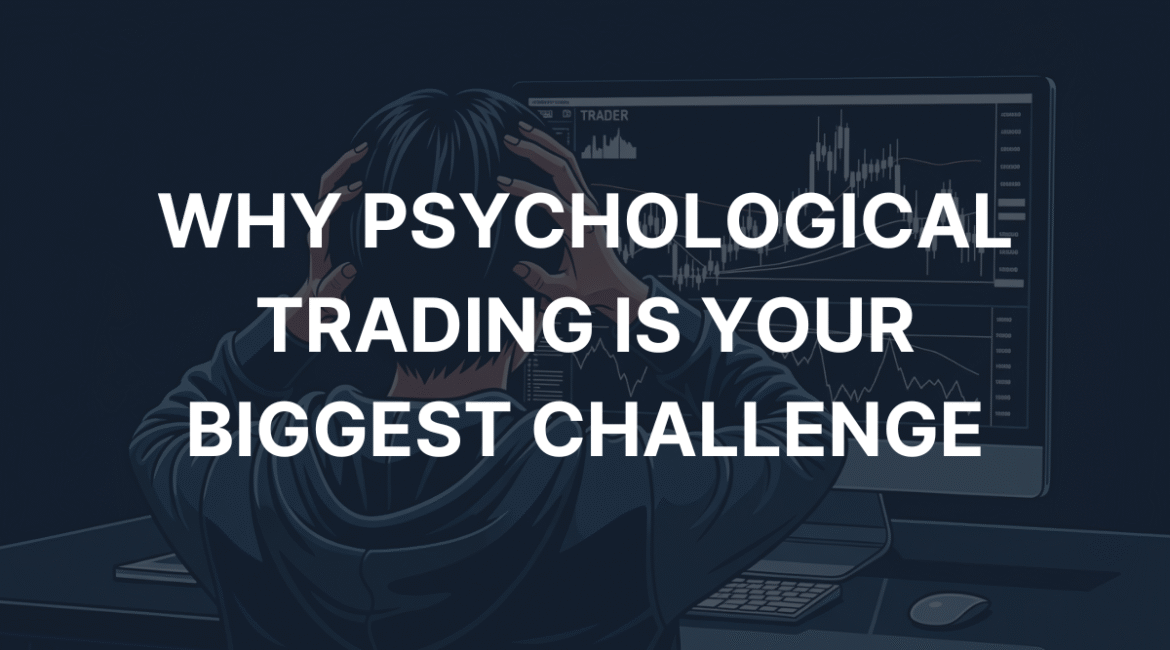
The market moves against you and, suddenly, all you want is for the discomfort to stop.
In the meantime, your competition is executing trades through machines that follow logic, not fear. If you’re acting on feelings — even if you’re smart, experienced, or intuitive — you’re already at a structural disadvantage.
But here’s the thing: psychological trading isn’t about becoming emotionless. It’s about noticing when your emotions are taking the wheel — and having a process in place to take back control.
Institutions Don’t Trade Like You Do (And It’s Not Your Fault)
Most of the market’s volume comes from institutional algorithms. And they don’t care how you feel.
- They follow strict, rule-based systems.
- They execute based on math, not emotion.
- They don’t care about being wrong on a single trade. They care about having an edge over time.
That means while you’re hesitating or hoping, they’re executing their plan. Your job isn’t to beat them at their game. Your job is to stop sabotaging yourself by trying to keep up with a pace that isn’t yours.
Why Emotional Trading Fails
In math, variables are predictable. You can plug in a value and get a result. But emotions are messy, impulsive, and often invisible until it’s too late.
If you’re about to enter a trade and you feel anything — hesitation, excitement, fear — that feeling is probably a liability, not a signal.
The more emotionally attached you are to a trade’s outcome, the more likely you are to break your own rules. You’ll start to react instead of reading the market. You’ll chase, doubt, freeze — or worse, justify bad decisions because they “felt right.”
That’s why psychological trading isn’t about suppressing emotions. It’s about designing a process that runs despite emotion, not with it.
The Silent Sabotage: When Emotions Take Over Logic
When you care too much about a trade, it gets personal. That’s when your thoughts spiral, your rules fade, and everything on the chart starts to look like a setup — even when it’s not.
Institutions don’t care. That’s why they win.
Emotional attachment makes objectivity nearly impossible.
What Is The “I Don’t Care” Size? And Why It Works
This is one of the simplest (and most powerful) mindset shifts you can make:
Trade so small that you genuinely don’t care if you lose
Yes. Even when it’s slow and feels boring, that’s exactly when you need to stay focused
Because when you trade small:
- You stop needing to be right.
- You stop making the wrong decisions every time the market moves against you
- You finally start seeing what the market is actually doing.
Al Brooks calls this the “I don’t care” size. And it changes everything.
Final Thoughts
You don’t need to trade emotionless. Your goal is to build a process that is emotion-proof
- Start with structure: Have a clear plan.
- Follow logic: Execute based on your rules, not on feelings.
- Use a position size that protects your mind as much as your account.
And above all, stop trying to win every single trade. That’s not how institutions think. And that’s not how consistency is built.
Want to Master Psychological Trading?
Start by mastering yourself. That’s the part of trading most people never study – and the results show it.
If you want to dive deep into the emotional and behavioral side of trading, I recommend the book Trading in the Zone by Mark Douglas. It’s a classic on how to master your mindset in the market. And if your goal is to advance your technical reading, learning to see the market logic that professionals use, the course by Al Brooks are the natural next step.
Related posts you might like:
